

Hey there! I'm a supplier of ceramic dewatering covers, and I've been in this game for quite a while. Today, I wanna share with you how I test the quality of these ceramic dewatering covers. It's a crucial part of what we do, 'cause ensuring top - notch quality is essential for our customers' satisfaction.
First off, let's talk about the raw materials. Good quality starts from the very beginning. Before we even start the manufacturing process, we carefully select the raw materials for our ceramic dewatering covers. We look at factors like the purity of the ceramic powders. The higher the purity, the better the physical and chemical properties of the final product. Impurities can affect things like the strength and the filtration efficiency of the covers. To test the raw materials, we often use spectrometry. It's a nifty tool that can tell us exactly what elements are present in the powder and in what quantities. This helps us make sure we're starting with the best stuff.
Once the raw materials pass the test, it's time to move on to the manufacturing process. The way these ceramic dewatering covers are made can have a huge impact on their quality. We pay close attention to the sintering process. Sintering is when we heat the ceramic at a high temperature to make it hard and dense. If the temperature is too low or the time is too short during sintering, the ceramic won't be fully formed, and it might be weak or have porosity issues. On the other hand, if it's over - sintered, the material can become brittle.
To check the quality of the sintered ceramic covers, we use a few different methods. One of the most basic is visual inspection. We look at the covers closely to see if there are any obvious cracks, chips, or uneven surfaces. Even a small crack can lead to leaks and reduce the effectiveness of the dewatering process. But visual inspection isn't enough on its own.
We also measure the density of the ceramic. A proper density is a sign of a well - sintered product. We use a simple Archimedes' principle - based method. We weigh the cover in air and then weigh it when it's submerged in a liquid. By calculating the difference, we can figure out the volume of the cover and then its density. If the density is within the expected range, it's a good indication that the sintering was successful.
Another important aspect of quality is the porosity of the ceramic dewatering covers. The pores in the ceramic are what allow water to pass through while retaining the solids. We use mercury intrusion porosimetry to measure the pore size distribution and porosity percentage. This technique involves forcing mercury into the pores of the ceramic under pressure. By measuring how much mercury is intruded at different pressures, we can get a detailed picture of the pore structure. A well - designed pore structure is crucial for efficient dewatering. If the pores are too large, solids might pass through, and if they're too small, the water flow rate will be low.
Now, let's talk about the mechanical properties of the ceramic dewatering covers. We need to make sure they can withstand the pressure and stresses they'll face during use. We conduct compression tests. In a compression test, we place the cover between two plates and gradually apply a load until it fails. By recording the maximum load the cover can bear, we can determine its compressive strength. This is important 'cause in a dewatering system, the covers are often under pressure from the liquid and the mechanical equipment.
We also perform flexural strength tests. This test is a bit like bending a stick. We support the ceramic cover at two points and apply a force in the middle until it breaks. Flexural strength is important because the covers might experience bending forces during installation or operation. If the flexural strength is too low, the covers could break easily, causing problems in the dewatering system.
In addition to these physical and mechanical tests, we also look at the chemical resistance of the ceramic dewatering covers. Depending on the application, the covers might come into contact with various chemicals. For example, in some industrial dewatering processes, they could be exposed to acids or alkalis. We soak samples of the covers in different chemical solutions for a certain period and then check for any signs of degradation. We measure things like weight loss, surface changes, and changes in mechanical properties. If the covers can resist the chemical attack without significant damage, it means they're suitable for use in those environments.
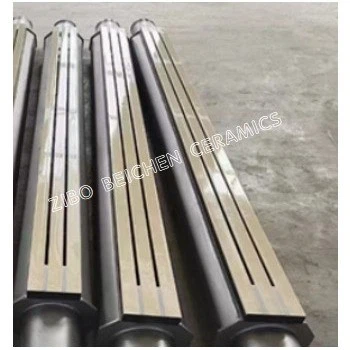
Now, I wanna mention some of the different types of ceramic dewatering covers we offer. We have the Ceramic Dewatering Element Felt Suction Box Cover. This type is great for applications where you need a smooth and efficient dewatering process, especially when dealing with fine solids. The felt suction box cover has a unique design that helps in better filtration and water removal.
Then there's the Ceramic Dewatering Element Wet Suction Box Cover. This cover is designed for wetter conditions. It has excellent water - handling capabilities and can maintain its performance even when there's a high water content in the material being dewatered.
And we also have the Ceramic Dewatering Element Curve Suction Box Cover. The curve design of this cover allows for a more uniform distribution of pressure and better contact with the dewatering material. It's particularly useful in applications where you need a more customized dewatering solution.
So, if you're in the market for high - quality ceramic dewatering covers, you know we've got the products that go through rigorous testing to ensure top - notch quality. Whether you're dealing with fine solids, wet materials, or need a specialized curve design, we've got you covered. If you're interested in learning more about our products or starting a procurement discussion, don't hesitate to reach out. We're here to work with you to find the best ceramic dewatering covers for your specific needs.

References
- Handbook of Ceramic Science and Technology. This reference provides in - depth knowledge about the properties and testing methods of ceramics.
- Journal of Materials Science. Articles in this journal often cover research on the manufacturing and testing of ceramic materials.